Sunday, 21 April 2013

Salute 2013.


A few of us attended Salute at the Excel in London and it proved to be another good day. All the usual suspects were there but unfortunately there was not SEEMS representation this year. One of the centre-piece games was the South London Warlords own 'Fleeced' games tying in with the loose theme of the show, Jason and the Argonauts. The game looked great fun and was fought using 1/6 scale figures with amazing looking skeletons.

Jason battles skeletons!
Here are some more snaps of games from the day...

Gripping Beast / 4Ground's massive Viking Hall.

Nantwich Gamers - When Chaos Reigns Normandy 1944.

Nantwich Gamers - When Chaos Reigns Normandy 1944.


A particular favourite of mine was the 3D version of the classic Snits Revenge board game by Tom Wham, designer of The Awful Grenn Things From Outer Space.


Frothers United - Snits Revenge.

Frothers United - Snits Revenge.

Frothers United - Snits Revenge.

Frothers United - Snits Revenge.

Planet of the Apes...

Frothers United - Return to the Planet of the Apes.

Frothers United - Return to the Planet of the Apes.

...and some more sci-fi...

Red Planet Miniatures - War on Mars.

Red Planet Miniatures - War on Mars.

Blakes Seven.

Blakes Seven.

...and some VBCW...

Gentlemens Wargames Parlour - VBCW.

Gentlemens Wargames Parlour - VBCW.

Gentlemens Wargames Parlour - VBCW.

The day managed to slip away very quickly but I did spend more time just gawking at the amazing games and less shopping. I had some great chats with some of the guys running games and a very interesting discussion with the designer for Sarissa Precision - the new 'Gaslamp Alley' buildings are lovely and I can't wait to pick up some of these.

 I picked up the new Crooked Dice 7th Voyage book plus I added a few packs of the lovely Foundry Argonauts to my current handful from the Wargames Foundry stall and very nice they were too!

Check out Big Lee's site for much better photos and a proper review!


Monday, 1 April 2013

4Ground Detached House.


Just built the lovely pre-painted 'Detached House' from 4Ground.

I also picked up the ruined version but have yet to tackle it. As this was the first attempt at a 4Ground building I really had no idea but following the instructions proved to be pretty simple even for me. One thing I would say is that a couple of the pictures on the instructions are not overly clear and I am sure at least one was in reverse! Having said that, it is all fairly instinctive and everything fitted together perfectly. I would recommend a good strong PVA glue (unlike the cheapo stuff I was using) as I ended up using a dab of super glue to fix the outer walls of the roof section.

A few quick pics, with a couple of Artizan British Paras I am working on for scale -

The completed house.

Loft space - plenty of storage.

Upper floor.

Lower floor.

Some Paras investigate...

I opted for the 'no damage' look as I intend to use this for various periods, including WW2 and some zombie fun and may well buy another to mix and match with the destroyed version.

The layers come apart simply and sit on little tabs at the corner of each floor. It all fits nice and snug and is quite sturdy on the two lower levels as the walls are effectively double thickness.

There is loads of room inside the buildings but I did find that my 2p based models are not able to stand in the doorways or stairwell. Anything up to about 25mm base size will fit perfectly well though. Good job most of my WW2 stuff is on 1p bases then!

Hopefully it will get to see some tabletop action soon as we are planning to have a first game of Troops, Weapons & Tactics in the near future!

Saturday, 23 February 2013

Doctor Who - Fourth Doctor Monsters!

Some random foes of the Fourth Doctor...

The society in and around Kaldor City was apparently almost wholly dependent on humanoid robots for servants and manual labour. The Sandminers, which made a major contribution to Kaldor's economy, were almost entirely crewed by robots of this type. Although superficially similar (all were designed to be aesthetically pleasing), the robots were constructed in varieties which differed in their intelligence, autonomy, and ability to communicate.

A 'Voc' from The Robots of Death.
The robots were physically stronger and more durable than most humans. It was generally assumed that fundamental protocols in the brains of the robots made it impossible for them to knowingly harm humans, although a robotics genius such as Taren Capel could override this precaution. The robots recognised their authorised controllers via their voice prints. A change in the controller's vocal pattern could result in apparently rebellious behaviour and non-compliance from a robot. All robots were identified by their class letter and a unique number, for example a Voc might be 'named' V7.

A 'Sandminer Voc' robot.  

DUM
The majority of the robots were D-class Dums, built without the ability to speak. On a sandminer the Dums mostly kept to the engineering decks, away from the human crew, making them appear less common than was the case. Dums wore dark green tunics. D84, a highly sophisticated Super-Voc class robot, was disguised as a Dum.
VOC
More able were the V-class Voc robots, who had the power of speech. In the absence of humans, Vocs performed essential control deck duties on a sandminer and were capable of running the vehicle without supervision. They could give back massages to human crew. They wore green tunics.
SUPER-VOC
Each sandminer's complement of robots included one SV-class Super-Voc, which had enhanced decision-making and organisational skills. The Super-Voc was effectively the leader of the robots, though still subservient to any of the authorised human crew. The Super-Voc wore a silver tunic.
Nimon. Horny?
The Nimon were large black-skinned humanoids with heads resembling the mythical minotaurs. Their horns could shoot out blasts of energy. Nimons drained energy directly from their victims, leaving them as husks. The Nimons had mighty, rumbling echoing voices. They were related to another minotaur-like species. (The God Complex)


The Nimons would feed on the population of an entire world, usually consuming it to extinction within a few years. As their food source got scarce, they would look for another planet ripe for conquest and draining.
Usually, one Nimon was sent to a planet, representing itself as a god with advanced technology. It would construct a maze-like Power Complex, a building-sized labyrinth of circuitry designed to generate a pocket black hole back to the Nimons' current planet. The Nimons would then migrate en masse to the new planet using capsules transmatted through the black hole. The Nimons would then drain that world dry and look for the next, continuing the cycle. They referred to this as the Great Journey of Life. The Nimons were very keen to conduct the Great Journey of Life to Earth, due to its prime position in the galaxy. From there, various alignments could offer millions of worlds for the Nimon migration to attack.

Experimental Prototype Robot K1 & the Doctor.
The Experimental Prototype Robot K1 was a robot designed and built by Professor J.P. Kettlewell of Think Tank. It was intended to replace humans in difficult and dangerous tasks, including mining and activities involving radioactive material.

K1 Robot - Big & Clever.
Weng-Chiang was the ancient Chinese god of abundance, having the power to make things grow. He was apparently an evil being, said to have breathed poisonous fumes from his mouth and kill men with light from his eyes. He was an ethnic corruption of Sung-Chiang, the god of thieves and criminals.

The Tong of the Black Scorpion was a fanatical cult convinced that he would return one day and and rule the world.

51st century time traveller Magnus Greel was believed to be Weng-Chiang by Li H'sen Chang when he found him, and thus Greel gained control over the cult. Descendents of the Tong soldiers who believed Greel to be Weng-Chiang were told stories of the god's anger.

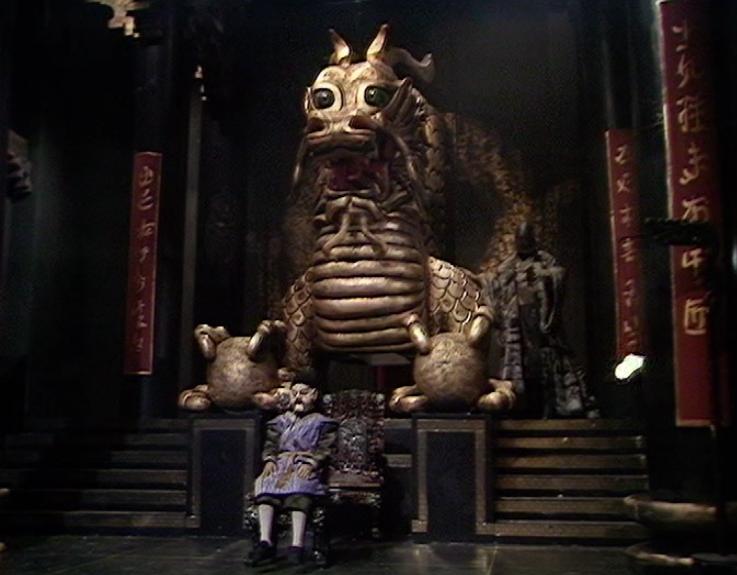
Look out behind yoooouu! Magnus Greel / Weng Chiang.
Magnus Greel was the Minister of Justice for the Supreme Alliance of Eastern States in the 51st century. When the Alliance fell to the Filipino Army in the Battle of Reykjavik, he became a wanted war criminal. He escaped by using an experimental time cabinet. He went to the late 19th century China and then to London, where he continued his depraved activities on a smaller scale. This made him the first human to officially travel through time.
Dragon statueIn Greel's time, the Earth was split into a number of warring alliances. The Icelandic Alliance and Greel's Supreme Alliance were at war. The Icelandic Alliance fell when Greel had the doll-like but homicidal cyborg known as the Peking Homunculus assassinate its commissioner Ingrid Bjarnsdottir, nearly precipitating World War VI.

He considered himself a driving force in the project in which his nation pioneered time travel. Apart from that he also personally experimented with the catalytic extraction chamber, an attempt to cannibalise life energies. One hundred thousand "enemies of the state" were massacred for these experiments.

As the Supreme Alliance's ironically named Minister of Justice, Greel carried out an atrocity earning him the title of the "Butcher of Brisbane". A human monster, Greel thought nothing of unprovoked murder and cannibalism.

After the defeat of the Supreme Alliance in the Battle of Reykjavik, Greel utilised a time cabinet to travel with the Peking Homunculus back in time to 19th century China. Using information provided by his fifth incarnation, the Doctor was able to prevent further bloodshed, bringing the brief Sixth World War to a close. 


Greel passed himself off as a god, Weng-Chiang, to Li H'sen Chang. With Chang posing as a conjurer and the Homunculus as a ventriloquist's dummy called Mr. Sin, they eventually found themselves in London.
The passage through time had caused great damage to Greel's DNA, deforming him. He wore a mask and concealing clothes to hide his true form. While Greel lived in fear of Time Agents, Chang abducted young women for Greel to use their life energy to restore himself - a method which was inherently flawed and only accelerated the damage.
Eventually he tried to restore his body using the time cabinet, but was instead shoved inside his own extraction chamber by the Fourth Doctor, resulting in fatal cellular collapse.

Zygons. Terrorising.
The Zygons were a race of metamorphic humanoids. They originated from the planet Zygor, but often tried to migrate away from it. They are solidly built humanoids with large, cone-shaped heads. Their heads, arms and torsos were covered in suckers, and they had deeply inset faces. Zygons had dark red blood and spoke in a gurgling whisper. They were stronger than humans and could live for centuries. They also had an earthy, iron odour and the ability to sting people with venomous barbs on their palms. These stings could stun, maim or kill. They left large welts on the affected area. Young Zygons were called hatchlings and were slimy and pale with shorter limbs. Hatchlings were mute, but much faster than adults.


Zygon technology was partly biological, with an organic look. This was exemplified by the Skarasen, a large, cybernetically enhanced creature from Zygor.  Zygons were also known to use the lactic fluid of the Skarasen as a source of food. Their use of organic ships was well known.

One of the most important Zygon discoveries was their body-print technology. The Zygons would capture a specimen, such as a human, and put them in a special receptacle. A Zygon could then take the form of this specimen, mimicking both voice and appearance. This body-print needed to be renewed every two hours, while the prisoners were kept alive but unconscious. Though they generally took the forms of humanoids, they could also mimic creatures of diverse sizes and shapes, such as dogs and cattle.
All figures are Harlequin / Black Tree Design.

Saturday, 2 February 2013

Wild West - Cherokee Braves.

The Cherokee Braves flag.

The 1st Cherokee Mounted Rifles was a Confederate States Army regiment which fought in the Indian Territory during the American Civil War. One of its commanders was Stand Watie.

Stand Watie.

Confederate officials commissioned Stand Watie a colonel in the Confederate States Army in July 1861 and authorized him to raise the First Regiment of Cherokee Mounted Volunteers. Cherokee Chief John Ross signed the Cherokee-Confederate treaty of alliance in October 1861 and raised the First Regiment of Cherokee Mounted Rifles, commanded by Col. John Drew. At this time Watie's regiment became the Second Regiment of Cherokee Mounted Rifles.

A group of dismounted Cherokee warriors led by Elias Adahy.

A portion of Drew's regiment deserted in late 1861. Following the Battle of Old Fort Wayne in October 1862, most of the remainder of Drew's men deserted. What remained of his troops was combined with Watie's regiment and reorganized as the First Regiment of Cherokee Mounted Rifles with Watie in command.

Major Thomas Pegg, Sgt. Jim "Yancy" Shaw and Corporal Ezekiel Carter. 

During the Civil War Watie's troops participated in twenty-seven major engagements and numerous smaller skirmishes. Although some of the engagements were set-piece battles, most of his activities utilized guerrilla tactics. Watie's men launched raids from south of the Canadian River throughout northern-held Indian Territory and into Kansas and Missouri, tying down thousands of Union troops. Poorly equipped and armed mostly with castoff rifles or captured weapons, the Cherokees were well suited to this type of warfare. Watie was promoted to brigadier general in May 1864.

Milos Proud and standard with his horse "Tama".

Watie's most spectacular victories included the capture of a Federal steamboat, the J. R. Williams, in June 1864 and the capture of a Union wagon train at the Second Battle of Cabin Creek in September 1864. His three most infamous actions were the burning of Rose Cottage, home of Chief John Ross, and the Cherokee Council House in October 1863, and the massacre of the First Kansas Colored Infantry and 2nd Regiment Kansas Volunteer Cavalry at the Hay Meadow fight in September 1864.

The raiding party!

In February 1865 Watie was given command of the Indian Division of Indian Territory but was unable to launch any offensive operations. He released most of his troops following the collapse of Confederate resistance in the spring of 1865. After participating in the Camp Napoleon Council in May, Stand Watie officially surrendered on June 23, 1865, becoming the last Confederate general to lay down his arms.

1st Cherokee Mounted Rifles.

Painted by Grouchy.

Saturday, 19 January 2013

Doctor Who - Romanadvoratrelundar.

Romanadvoratrelundar was a member of the House of Heartshaven. She graduated with a "triple first" from the Time Lord Academy on Gallifrey. One of her early jobs was working in the Bureau of Ancient Records on Gallifrey.

Romana I

Romanadvoratrelundar seemed to be a single, long name when she introduced herself to the Fourth Doctor. He seemed to have trouble pronouncing the full name, and quickly shortened it to "Romana". The Doctor later called her "Miss Dvoratrelundar" when she was a witness during his trial before the Megara.

Romana I.
Romana first met the Doctor when she was a young (about one hundred thirty-nine) and relatively inexperienced Time Lady.

Romana I in white dress. Nom.
 The White Guardian originally assigned Romana to assist the Doctor during the quest for the Key to Time. Romana first appears in The Ribos Operation, and was intended as a contrast to her predecessor, the savage Leela. Romana is initially haughty and somewhat arrogant, looking down on the Doctor (whom she considers to be her academic inferior) and responding to his initial resentment at her presence with icy put-downs. However, she soon gains an appreciation for the Doctor's experience and sense of adventure, and begins to respect him as a teacher.

The Doctor and Romana.  Icy put down.

Romana II

The introduction of Romana's second incarnation in Destiny of the Daleks, treats the concept of regeneration humorously. At the beginning of the serial, Romana changes bodily forms several times, rather like someone casually trying on different outfits, before deciding to take the form of Princess Astra (who had been played by Lalla Ward in the final serial of Season 16, The Armageddon Factor.) This regeneration scene is controversial with some fans, as it does not conform with how regeneration is treated with regards to the Doctor or other Time Lord characters.

Princess Astra - Romana's next 'chosen' regenerative form.

The Princess was the sixth child of the sixth dynasty of the sixth royal house of Atrios. Astra was kidnapped by the Shadow and taken to the third planet. She was later transformed to her true shape. After the Fourth Doctor had defeated the Black Guardian, Princess Astra was restored to her humanoid form and returned to normal life. She ruled her planet and presumably married Merak.

Romana II in her distinctive red coat.
Romana II enjoys a more intimate relationship with the Doctor than her predecessor, to the point that some fans have assumed a romantic relationship with the Doctor. Although a relationship was never explicitly shown or intended by the writers, many fans have found the signs of a romantic relationship particularly evident in the story City of Death. In many ways, she is the companion most like her Doctor - besides being of the same race and comparable intelligence, she occasionally mimics his sense of style, wields her own sonic screwdriver and can occasionally get the better of him in moments of banter and more practical situations. As her practical experience develops, she also becomes more assured and capable in the situations she encounters.

Romana I and Romana II attempt to confuse the Doctor...
At the end of the serial Meglos, Romana receives word from the Time Lords recalling her to Gallifrey. The opening of the next serial Full Circle makes it clear that, having travelled with the Doctor, she no longer desires to return home. Before the issue can be resolved, the TARDIS falls through a Charged Vacuum Emboitment. Her final television appearance was in Warriors' Gate, where, along with the robot dog K-9, she leaves to forge her own path in the parallel universe of E-space when faced with a choice of remaining there or returning to Gallifrey.

Alternate Romana I and Romana II painted for me by Matt Slade.

Saturday, 5 January 2013

Strange Aeons - Agents Assemble!


The Threshold Agents (under the Department of Mythos Studies) assemble, ready for action.


1. Daphne Lamont
2. Hermione Peverall
3. Dr. Amelie "Lena" von Heidingsfelder
4. Winifred "Winnie" Hodge


1. Captain Vincent Wycott
2. Dermot Boyle
3. Hon. Basil Ignatious Howard G.C.
4. Jonathan Winstanley


All figures are from Copplestone.