Saturday, 23 February 2013

Doctor Who - Fourth Doctor Monsters!

Some random foes of the Fourth Doctor...

The society in and around Kaldor City was apparently almost wholly dependent on humanoid robots for servants and manual labour. The Sandminers, which made a major contribution to Kaldor's economy, were almost entirely crewed by robots of this type. Although superficially similar (all were designed to be aesthetically pleasing), the robots were constructed in varieties which differed in their intelligence, autonomy, and ability to communicate.

A 'Voc' from The Robots of Death.
The robots were physically stronger and more durable than most humans. It was generally assumed that fundamental protocols in the brains of the robots made it impossible for them to knowingly harm humans, although a robotics genius such as Taren Capel could override this precaution. The robots recognised their authorised controllers via their voice prints. A change in the controller's vocal pattern could result in apparently rebellious behaviour and non-compliance from a robot. All robots were identified by their class letter and a unique number, for example a Voc might be 'named' V7.

A 'Sandminer Voc' robot.  

DUM
The majority of the robots were D-class Dums, built without the ability to speak. On a sandminer the Dums mostly kept to the engineering decks, away from the human crew, making them appear less common than was the case. Dums wore dark green tunics. D84, a highly sophisticated Super-Voc class robot, was disguised as a Dum.
VOC
More able were the V-class Voc robots, who had the power of speech. In the absence of humans, Vocs performed essential control deck duties on a sandminer and were capable of running the vehicle without supervision. They could give back massages to human crew. They wore green tunics.
SUPER-VOC
Each sandminer's complement of robots included one SV-class Super-Voc, which had enhanced decision-making and organisational skills. The Super-Voc was effectively the leader of the robots, though still subservient to any of the authorised human crew. The Super-Voc wore a silver tunic.
Nimon. Horny?
The Nimon were large black-skinned humanoids with heads resembling the mythical minotaurs. Their horns could shoot out blasts of energy. Nimons drained energy directly from their victims, leaving them as husks. The Nimons had mighty, rumbling echoing voices. They were related to another minotaur-like species. (The God Complex)


The Nimons would feed on the population of an entire world, usually consuming it to extinction within a few years. As their food source got scarce, they would look for another planet ripe for conquest and draining.
Usually, one Nimon was sent to a planet, representing itself as a god with advanced technology. It would construct a maze-like Power Complex, a building-sized labyrinth of circuitry designed to generate a pocket black hole back to the Nimons' current planet. The Nimons would then migrate en masse to the new planet using capsules transmatted through the black hole. The Nimons would then drain that world dry and look for the next, continuing the cycle. They referred to this as the Great Journey of Life. The Nimons were very keen to conduct the Great Journey of Life to Earth, due to its prime position in the galaxy. From there, various alignments could offer millions of worlds for the Nimon migration to attack.

Experimental Prototype Robot K1 & the Doctor.
The Experimental Prototype Robot K1 was a robot designed and built by Professor J.P. Kettlewell of Think Tank. It was intended to replace humans in difficult and dangerous tasks, including mining and activities involving radioactive material.

K1 Robot - Big & Clever.
Weng-Chiang was the ancient Chinese god of abundance, having the power to make things grow. He was apparently an evil being, said to have breathed poisonous fumes from his mouth and kill men with light from his eyes. He was an ethnic corruption of Sung-Chiang, the god of thieves and criminals.

The Tong of the Black Scorpion was a fanatical cult convinced that he would return one day and and rule the world.

51st century time traveller Magnus Greel was believed to be Weng-Chiang by Li H'sen Chang when he found him, and thus Greel gained control over the cult. Descendents of the Tong soldiers who believed Greel to be Weng-Chiang were told stories of the god's anger.

Look out behind yoooouu! Magnus Greel / Weng Chiang.
Magnus Greel was the Minister of Justice for the Supreme Alliance of Eastern States in the 51st century. When the Alliance fell to the Filipino Army in the Battle of Reykjavik, he became a wanted war criminal. He escaped by using an experimental time cabinet. He went to the late 19th century China and then to London, where he continued his depraved activities on a smaller scale. This made him the first human to officially travel through time.

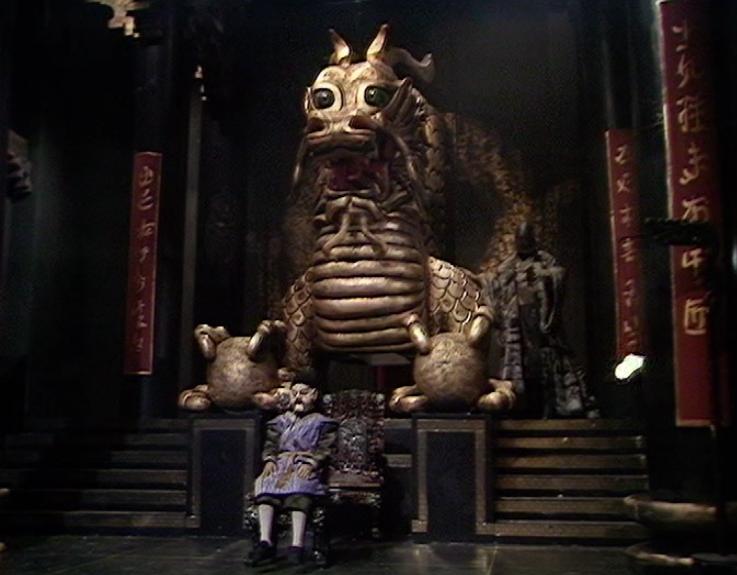
Dragon statueIn Greel's time, the Earth was split into a number of warring alliances. The Icelandic Alliance and Greel's Supreme Alliance were at war. The Icelandic Alliance fell when Greel had the doll-like but homicidal cyborg known as the Peking Homunculus assassinate its commissioner Ingrid Bjarnsdottir, nearly precipitating World War VI.

He considered himself a driving force in the project in which his nation pioneered time travel. Apart from that he also personally experimented with the catalytic extraction chamber, an attempt to cannibalise life energies. One hundred thousand "enemies of the state" were massacred for these experiments.

As the Supreme Alliance's ironically named Minister of Justice, Greel carried out an atrocity earning him the title of the "Butcher of Brisbane". A human monster, Greel thought nothing of unprovoked murder and cannibalism.

After the defeat of the Supreme Alliance in the Battle of Reykjavik, Greel utilised a time cabinet to travel with the Peking Homunculus back in time to 19th century China. Using information provided by his fifth incarnation, the Doctor was able to prevent further bloodshed, bringing the brief Sixth World War to a close. 


Greel passed himself off as a god, Weng-Chiang, to Li H'sen Chang. With Chang posing as a conjurer and the Homunculus as a ventriloquist's dummy called Mr. Sin, they eventually found themselves in London.
The passage through time had caused great damage to Greel's DNA, deforming him. He wore a mask and concealing clothes to hide his true form. While Greel lived in fear of Time Agents, Chang abducted young women for Greel to use their life energy to restore himself - a method which was inherently flawed and only accelerated the damage.
Eventually he tried to restore his body using the time cabinet, but was instead shoved inside his own extraction chamber by the Fourth Doctor, resulting in fatal cellular collapse.

Zygons. Terrorising.
The Zygons were a race of metamorphic humanoids. They originated from the planet Zygor, but often tried to migrate away from it. They are solidly built humanoids with large, cone-shaped heads. Their heads, arms and torsos were covered in suckers, and they had deeply inset faces. Zygons had dark red blood and spoke in a gurgling whisper. They were stronger than humans and could live for centuries. They also had an earthy, iron odour and the ability to sting people with venomous barbs on their palms. These stings could stun, maim or kill. They left large welts on the affected area. Young Zygons were called hatchlings and were slimy and pale with shorter limbs. Hatchlings were mute, but much faster than adults.


Zygon technology was partly biological, with an organic look. This was exemplified by the Skarasen, a large, cybernetically enhanced creature from Zygor.  Zygons were also known to use the lactic fluid of the Skarasen as a source of food. Their use of organic ships was well known.

One of the most important Zygon discoveries was their body-print technology. The Zygons would capture a specimen, such as a human, and put them in a special receptacle. A Zygon could then take the form of this specimen, mimicking both voice and appearance. This body-print needed to be renewed every two hours, while the prisoners were kept alive but unconscious. Though they generally took the forms of humanoids, they could also mimic creatures of diverse sizes and shapes, such as dogs and cattle.
All figures are Harlequin / Black Tree Design.

Saturday, 2 February 2013

Wild West - Cherokee Braves.

The Cherokee Braves flag.

The 1st Cherokee Mounted Rifles was a Confederate States Army regiment which fought in the Indian Territory during the American Civil War. One of its commanders was Stand Watie.

Stand Watie.

Confederate officials commissioned Stand Watie a colonel in the Confederate States Army in July 1861 and authorized him to raise the First Regiment of Cherokee Mounted Volunteers. Cherokee Chief John Ross signed the Cherokee-Confederate treaty of alliance in October 1861 and raised the First Regiment of Cherokee Mounted Rifles, commanded by Col. John Drew. At this time Watie's regiment became the Second Regiment of Cherokee Mounted Rifles.

A group of dismounted Cherokee warriors led by Elias Adahy.

A portion of Drew's regiment deserted in late 1861. Following the Battle of Old Fort Wayne in October 1862, most of the remainder of Drew's men deserted. What remained of his troops was combined with Watie's regiment and reorganized as the First Regiment of Cherokee Mounted Rifles with Watie in command.

Major Thomas Pegg, Sgt. Jim "Yancy" Shaw and Corporal Ezekiel Carter. 

During the Civil War Watie's troops participated in twenty-seven major engagements and numerous smaller skirmishes. Although some of the engagements were set-piece battles, most of his activities utilized guerrilla tactics. Watie's men launched raids from south of the Canadian River throughout northern-held Indian Territory and into Kansas and Missouri, tying down thousands of Union troops. Poorly equipped and armed mostly with castoff rifles or captured weapons, the Cherokees were well suited to this type of warfare. Watie was promoted to brigadier general in May 1864.

Milos Proud and standard with his horse "Tama".

Watie's most spectacular victories included the capture of a Federal steamboat, the J. R. Williams, in June 1864 and the capture of a Union wagon train at the Second Battle of Cabin Creek in September 1864. His three most infamous actions were the burning of Rose Cottage, home of Chief John Ross, and the Cherokee Council House in October 1863, and the massacre of the First Kansas Colored Infantry and 2nd Regiment Kansas Volunteer Cavalry at the Hay Meadow fight in September 1864.

The raiding party!

In February 1865 Watie was given command of the Indian Division of Indian Territory but was unable to launch any offensive operations. He released most of his troops following the collapse of Confederate resistance in the spring of 1865. After participating in the Camp Napoleon Council in May, Stand Watie officially surrendered on June 23, 1865, becoming the last Confederate general to lay down his arms.

1st Cherokee Mounted Rifles.

Painted by Grouchy.

Saturday, 19 January 2013

Doctor Who - Romanadvoratrelundar.

Romanadvoratrelundar was a member of the House of Heartshaven. She graduated with a "triple first" from the Time Lord Academy on Gallifrey. One of her early jobs was working in the Bureau of Ancient Records on Gallifrey.

Romana I

Romanadvoratrelundar seemed to be a single, long name when she introduced herself to the Fourth Doctor. He seemed to have trouble pronouncing the full name, and quickly shortened it to "Romana". The Doctor later called her "Miss Dvoratrelundar" when she was a witness during his trial before the Megara.

Romana I.
Romana first met the Doctor when she was a young (about one hundred thirty-nine) and relatively inexperienced Time Lady.

Romana I in white dress. Nom.
 The White Guardian originally assigned Romana to assist the Doctor during the quest for the Key to Time. Romana first appears in The Ribos Operation, and was intended as a contrast to her predecessor, the savage Leela. Romana is initially haughty and somewhat arrogant, looking down on the Doctor (whom she considers to be her academic inferior) and responding to his initial resentment at her presence with icy put-downs. However, she soon gains an appreciation for the Doctor's experience and sense of adventure, and begins to respect him as a teacher.

The Doctor and Romana.  Icy put down.

Romana II

The introduction of Romana's second incarnation in Destiny of the Daleks, treats the concept of regeneration humorously. At the beginning of the serial, Romana changes bodily forms several times, rather like someone casually trying on different outfits, before deciding to take the form of Princess Astra (who had been played by Lalla Ward in the final serial of Season 16, The Armageddon Factor.) This regeneration scene is controversial with some fans, as it does not conform with how regeneration is treated with regards to the Doctor or other Time Lord characters.

Princess Astra - Romana's next 'chosen' regenerative form.

The Princess was the sixth child of the sixth dynasty of the sixth royal house of Atrios. Astra was kidnapped by the Shadow and taken to the third planet. She was later transformed to her true shape. After the Fourth Doctor had defeated the Black Guardian, Princess Astra was restored to her humanoid form and returned to normal life. She ruled her planet and presumably married Merak.

Romana II in her distinctive red coat.
Romana II enjoys a more intimate relationship with the Doctor than her predecessor, to the point that some fans have assumed a romantic relationship with the Doctor. Although a relationship was never explicitly shown or intended by the writers, many fans have found the signs of a romantic relationship particularly evident in the story City of Death. In many ways, she is the companion most like her Doctor - besides being of the same race and comparable intelligence, she occasionally mimics his sense of style, wields her own sonic screwdriver and can occasionally get the better of him in moments of banter and more practical situations. As her practical experience develops, she also becomes more assured and capable in the situations she encounters.

Romana I and Romana II attempt to confuse the Doctor...
At the end of the serial Meglos, Romana receives word from the Time Lords recalling her to Gallifrey. The opening of the next serial Full Circle makes it clear that, having travelled with the Doctor, she no longer desires to return home. Before the issue can be resolved, the TARDIS falls through a Charged Vacuum Emboitment. Her final television appearance was in Warriors' Gate, where, along with the robot dog K-9, she leaves to forge her own path in the parallel universe of E-space when faced with a choice of remaining there or returning to Gallifrey.

Alternate Romana I and Romana II painted for me by Matt Slade.

Saturday, 5 January 2013

Strange Aeons - Agents Assemble!


The Threshold Agents (under the Department of Mythos Studies) assemble, ready for action.


1. Daphne Lamont
2. Hermione Peverall
3. Dr. Amelie "Lena" von Heidingsfelder
4. Winifred "Winnie" Hodge


1. Captain Vincent Wycott
2. Dermot Boyle
3. Hon. Basil Ignatious Howard G.C.
4. Jonathan Winstanley


All figures are from Copplestone.

Saturday, 29 December 2012

Doctor Who - The First Doctor.

Here we have the First Doctor. No companions yet (apart from Polly) and boy are there a lot to choose from!

Susan Foreman
Barbara Wright
Ian Chesterton
Vicki
Steven Taylor
Katarina (no miniature...)
Sara Kingdom
Dodo Chaplet
Polly
Ben Jackson

For now, here is the Doctor and a couple of old adversaries...

The First Doctor.
A Chumbley was a type of robot encountered by the First Doctor, Vicki and Steven on a doomed planet where the Rills and Drahvins had crashed. They were created by and under the control of the Rills. Their true, Rill name was unknown. "Chumbley" was what Vicki called them, based upon the "wobbly" sound they made when moving. When she told the Rills she had named the robots "Chumblies", they did not object. Indeed, they used the term themselves.

The Doctor and assorted robots. A 'Chumbley', plus Krotons and Quarks (that actually  appeared opposite the Second Doctor)

The Doctor deduced they were blind because they seemed to feel their way around the exterior of the TARDIS. Later, he determined they had the ability to detect sound waves and heat. They were powered by a form of magnetism and could be immobilised by ensnaring them in a metal mesh. They resisted gunfire by voluntary deactivation. When they switched themselves off, their bodies telescoped down, reducing their height by roughly half. The concentric rings of metal that comprised their bodies folded into each other, thereby protecting the interior of the robot.

Their primary task was to act as a translator between the Rills and other beings. They could analyse the speech patterns of other beings and allow the thoughts of the Rills to be "spoken" through their onboard speakers in the language of the listener. They continued to appear around the Drahvins' ship because the Rills were merely trying to communicate.

The Chumblies assisted the Rills in other ways. Because the Rills could not metabolise oxygen, the Chumblies were the only way the Rills could experience oxygen-rich planets, such as the one on which they had crashed. They were thus a kind of probe, sending data back to their masters.

Although principally tools of exploration and communication, the Chumblies ways of attacking. They were equipped with weapons. They had flame-throwers and could also fire projectiles akin to bullets and ammonia bombs.

Drahvins and a Chumbley.

The Zarbi appeared in the 1965 First Doctor story The Web Planet and are an ant-like insectoid species, with some characteristics associated with beetles, from the planet Vortis, which were controlled by the power of the Animus. They are roughly eight feet long, and the Menoptra claim that they are "little more than cattle".

The Doctor is not impressed by the Zarbi.
.
They possess little intelligence but were not at all aggressive until the Animus arrived. They were enslaved to the alien consciousness and considered the butterfly-like Menoptra their mortal enemies. Only they could control the woodlouse-like venom grubs, also known as larvae guns.

They returned to their normal ways after the Animus was defeated by the First Doctor, Ian Chesterton, Barbara Wright and Vicki. It is presumed that the various species on Vortis are now living peacefully together.

The Doctor looks on as the Celestial Toymaker pontificates on his dastardly plans...

The Toymaker is immortal, having already lived for millions of years. Having been cast out from an alternative universe, he obeys a different set of physical laws. The years of isolation have driven him mad, and he seeks distraction in the playing of games.

If the Toymaker loses a game, his world is destroyed (although he is powerful enough to rebuild it). If a contestant loses, he is added to the game as a toy, and if he wins, he is destroyed with the world. Either way, the contestant cannot win; the reward for both failure and success is the same: eternal existence at the Toymaker's side. The Toymaker is manipulative and can turn people, as the First Doctor comments, "into his playthings". As he demonstrates, he is a being of great power, judging from how he effortlessly makes the Doctor invisible and, for a while, mute.

He uses his enormous power for self-satisfaction and bullying. Kind of the Doctor Who version of 'Q'.


Figures are Black Tree Design / Harlequin.

Saturday, 22 December 2012

Doctor Who - The Second Doctor.

Here we have the Second Doctor and a few companions.

Companions with the Second Doctor were - 

Polly
Ben Jackson
Jamie McCrimmon
Victoria Waterfield
Zoe Heriot

Still have to do Ben Jackson but here are the rest of the gang and a few evil aliens...

Zoe Heriot, The Doctor and Jamie McCrimmon.

Zoe first appears in the serial The Wheel in Space, where she is the librarian on board Space Station W3, also known as the Wheel. When the Cybermen attack, she aids the Doctor and Jamie in defeating them before stowing away aboard the TARDIS.

Zoe's age is not given in the series, but according to initial publicity she was fifteen when she joined the TARDIS crew. She holds a degree in pure mathematics and is a genius, with intelligence scores comparable to the Doctor's. Coupled with her photographic memory and the advanced learning techniques of her era, this makes her somewhat like a human calculator, able to perform complicated mathematics in her head. Part of the reason for her wanting to travel with the Doctor is her chafing at the restrictions and sterile surroundings of her station-bound existence. However, her real world experience is severely limited, and that gives her an ability to frequently get herself in trouble.

Together with the Doctor and Jamie, she meets the Cybermen again when they invade 20th century London, enters the surreal Land of Fiction, fights the Ice Warriors and survives the battlefields of the War Chief's war games. Her journeys with the Doctor come to an end in that serial, when the Time Lords finally catch up with the Doctor. As well as forcing a regeneration on him and exiling him to Earth, the Time Lords return Jamie and Zoe to their own times, wiping the memory of their experiences with the Doctor (save for their first encounters with him) in the process.

James Robert McCrimmon was the son of Donald McCrimmon - a piper, like his father and his father's father. Jamie first appears in The Highlanders, encountering the Doctor, Ben and Polly in the aftermath of the Battle of Culloden in 1746. At the end of the story, Polly suggests that the Doctor take Jamie along with them. Jamie continues to travel with the Doctor even after Ben and Polly leave the TARDIS at the end of The Faceless Ones. He appears in all but the very first Second Doctor serial, The Power of the Daleks, and in more episodes than any other companion, although Tegan Jovanka served with the Doctor for the longest continuous period in terms of years on the series.

Zoe, Jamie and the Doctor.

Jamie shares a lively, bantering relationship with the Doctor, and during his time in the series sees the arrival and departure of first Victoria Waterfield and finally Zoe Heriot. Jamie, being a product of his time, is always solicitous and gentlemanly towards the women who travel with him. Jamie does not have the background to always understand the situations his adventures with the Doctor take him into, but is quick enough to translate high technology and concepts into equivalents he can understand and deal with. His relationship with the Doctor is not always smooth and in The Evil of the Daleks he comes close to leaving the Doctor whom he feels has been manipulating him and Victoria to discover the human factor for the Daleks, without thinking about the consequences. His battle cry "Creag an tuire", in Scottish Gaelic, translates to "The Boar's Rock." It is similar to Creag an tuirc, the motto of the MacLaren Clan of Scotland.

Together with the Doctor, Jamie encounters Cybermen, Daleks, the Yeti in the London Underground, the Ice Warriors, and many other dangers. Jamie is particularly fond and protective of Victoria, due in part to her being an elegant Victorian lady. For example, in The Ice Warriors Jamie's first priority is to rescue Victoria despite being injured to the point where he can't walk. Jamie is heartbroken when Victoria decides to stay with the Harris family at the end of Fury from the Deep, to the point of even being briefly angry with the Doctor for allowing her to leave (The Wheel in Space). Jamie initially finds Zoe's more modern attitudes and bossy nature irritating, but eventually adopts the same protective attitude disguised by the same bantering he engages in with the Doctor. Often Jamie's simple common sense beats Zoe's strict logic, such as in The Dominators where Jamie realises that the erupting volcano is going to threaten, while the Doctor and Zoe are still congratulating themselves.

Jamie's travels with the Doctor come to an end on the battlefields of The War Games, when the Time Lords finally put the Doctor on trial for interfering with the universe. For his offences, the Doctor is forced to regenerate and exiled to Earth. Jamie and Zoe are returned to their own time, their memories of the Doctor wiped, save for their first encounters with him. When last seen, Jamie is fighting an English redcoat back on the fields of Scotland.

Frazer Hines returned to Doctor Who as an illusory image of Jamie in the 20th anniversary special The Five Doctors. He also reprised the role in the 1985 serial The Two Doctors alongside Patrick Troughton and Colin Baker as the Second and Sixth Doctors respectively.

Victoria Waterfield and Polly.

Victoria first appears in the 1967 serial The Evil of the Daleks. She is the daughter of scientist Edward Waterfield who in 1866 is experimenting with time travel and has attracted the attention of the Daleks. In order to assure Waterfield's collaboration with their capture of the Doctor and their experiments with the Human and Dalek Factors, the Daleks with the help of Theodore Maxtable took Victoria as a prisoner. To measure his emotional responses, they then manipulated Jamie McCrimmon into rescuing her, although they ultimately re-captured her and took her to Skaro. At the conclusion of the adventure, Waterfield is killed saving the Doctor's life, and asks him to take care of Victoria. The Doctor and Jamie take her in as part of the TARDIS crew.

The Doctor, Victoria and Jamie.

On the outside, Victoria is a typically fragile lady of her era, frequently screaming when faced with the creatures the Doctor and his companions encounter in their travels, such as the Cybermen and theYeti, the latter which are automatons of the disembodied Great Intelligence. However, this exterior hides an inner strength that crops up when needed. Victoria may be young, but she has an instinct for when she is being lied to, and her sensibility is a contrast to the recklessness of Jamie and the curiosity of the Doctor. Jamie, in particular, is very protective towards and fond of Victoria, and is heartbroken when she chooses to leave.

Despite being a good match to her two companions, Victoria eventually finds herself unsuited to extended travel with the Doctor. At the conclusion of the serial Fury from the Deep, she decides to leave the TARDIS, settling with a family named Harris in the 20th century. Her subsequent life is not shown in the television series. She is mentioned, but not seen to be travelling with the Second Doctor in the 1985 serial The Two Doctors.

Polly and the Doctor.

Polly first appears in the First Doctor serial, The War Machines, where she is working as a secretary to Professor Brett. Brett develops the artificial intelligence known as WOTAN, and Polly meets the Doctor and Dodo when they come to investigate it. Polly befriends Dodo and takes her to a London nightclub called the Inferno, where they meet Ben Jackson and try to cheer up the merchant seaman. When Polly is accosted by another patron in the Inferno, Ben comes to her rescue. Eventually, Ben and Polly aid the Doctor in his fight against WOTAN when the computer tries to take over the world. They are the bearers of the news of Dodo's decision to stay in 1966 to the Doctor, and accidentally get carried away in the TARDIS when they try to return Dodo's key to the time machine.

Polly, in contrast to Dodo, is a more sophisticated and hip young woman of the 1960s — vivacious, attractive, and alternately shy and aggressive. She and Ben make an odd couple, but she is receptive to Ben's protective urges, and he in turn finds her elegant and posh, giving her the nickname "Duchess". Polly is present with Ben when the First Doctor regenerates into the Second, and continues to travel with the Second Doctor.

Eventually, the TARDIS finds its way back to 1966 London (in The Faceless Ones) on the very day Ben and Polly had left (although about a year had passed for them). They decide to remain behind to resume their lives without disruption as the Doctor and Jamie travel on.

What happens to Polly after her return to Earth is not certain. The Doctor seems to think that Ben will become an Admiral and that Polly will look after Ben, but it is unclear if this is a prediction or simply wishing them well. In The Sarah Jane Adventures story Death of the Doctor, Sarah Jane mentions that Polly is now working at an orphanage in India with Ben.

Ice Warriors. 
The Ice Warriors are a race of reptilian-like humanoids. The race originated on Mars, and first appeared in the 1967 serial The Ice Warriors where they encountered the Second Doctor and his companions Jamie and Victoria. The name Ice Warrior is not the name of their species, but was applied to them by an Earth scientific team in the Martians' first on-screen appearance.

Their first on-screen appearance was in the 1967 story The Ice Warriors, set at a time in the future when the world was in the grip of a new ice age. A scientific team sent to halt the advance of the glaciers discovered a spacecraft buried underneath the ice, where it had lain for thousands of years together with its Ice Warrior crew. The Martians revived and attempted to take over the scientific base, but were defeated by the Second Doctor and their ship destroyed as it tried to take off.

Their next appearance was in the 1969 serial The Seeds of Death,which took place in the mid-21st century. In that story, the world had grown dependent on the matter transmission system T-Mat. An Ice Warrior strike force seized control of the T-Mat relay on the Moon, using it to send the titular seeds to Earth, which were designed to alter the planet's atmosphere to be hospitable to Martian life, by reducing the atmosphere's oxygen content to one-twentieth, exactly like Mars. The plan was foiled by the Second Doctor and his companions Jamie and Zoe, and the invading Martian fleet was sent into an orbit around the Sun.

Ice Warriors.

By the time of 1972's The Curse of Peladon, the Ice Warriors had renounced violence (except in self-defence) and become respected members of a Galactic Federation that included Earth, Mars, Alpha Centauri and Arcturus. When the Third Doctor encountered them on a diplomatic mission to decide the admission of the planet Peladon to the Federation, he was initially distrustful, believing them to be behind an attempted sabotage of the proceedings. However, the culprit turned out to be someone else.

In the 1974 serial The Monster of Peladon (which took place 50 years after Curse), the Ice Warriors returned to Peladon as Federation peacekeeping troops. The leader of the Martian troops, Azaxyr, was working with Galaxy 5, which was at war with the Federation. Seeking a return to the race's warrior past, he tried to impose martial law and take over Peladon, but was stopped by the Peladonians, who were aided by the Third Doctor.

A possible unseen adventure involving the Ice Warriors is alluded to in Castrovalva. The newly-regenerated and still unstable Fifth Doctor regresses to an earlier personality and memory, saying, "Not far now, Brigadier, unless the Ice Warriors get there first!". The final New Adventures novel, The Dying Days by Lance Parkin, features a 1997 invasion of Earth by the Ice Warriors, and also states that the Brigadier had not encountered them before.

In the 2009 episode, "The Waters of Mars", the Doctor mentions the legend of the Ice Warriors, calling them "a fine and noble race who built an empire out of snow." He also theorises that the alien entity that seems to be sentient water pursuing them in the episode was known to the Ice Warriors, who froze it in an underground glacier on Mars to prevent its escape.

Jamie and The Doctor face off against some fearsome 'Yeti'.
The Yeti,  although resembling the cryptozoological creatures also called the Yeti, are in actuality alien robots. Their external appearance, that of a huge hairy biped, disguises a small spherical mechanism that provides its motive power.

Yeti having a shindig.

The Yeti serve the Great Intelligence, a disembodied entity from another dimension, which tried to form a physical body in order to conquer the Earth. The Yeti are initially a ruse to scare off curiosity seekers, and later form an army serving the Great Intelligence.

Rago the Dominator.
The Dominators were a race of near-humans who controlled much of the Ten Galaxies. They were intensely utilitarian, and hesitant to misuse any amount of energy for matters that did not directly benefit them and their mission. This was especially the case in energy management of their robotic laborers, Quarks.

Toba. Grumpy.

Quarks were cuboid in shape with a sphere on top. Two spikes came from opposite sides of this sphere, with one on top. They had rectangular compartments on their chests into which their cuboid arms folded. Their arms were equipped with weaponry and manipulating appendages. The spore spikes were red along with the rim attaching them all. The rest of the sphere was black and the body was grey. The Quarks' feet were large pieces of metal in the shape of a block; poles attached these to the body.

Quarks and Krotons, with a 'Chumbley' and the first Doctor.

The TARDIS arrives on the unnamed planet of the Gonds, who are ruled and taught in a form of self-perpetuating slavery by the alien Krotons — crystalline beings whose ship, the Dynatrope, crash-landed there thousands of years earlier after being damaged in a space battle.

The Krotons are in suspended animation, in a crystalline slurry form, awaiting a time when they can be reconstituted by absorption of mental energy. Periodically, the two most brilliant Gond students are received into the Dynatrope, nominally to become "companions of the Krotons" but in truth to have their mental energy drained, after which they are killed.

Krotons - not very scary.

When the Doctor and Zoe take the students' test, their mental power is sufficient to reanimate the Krotons. The Doctor discovers that their life system is based on tellurium. With help from the Gond scientist Beta, he destroys them and their ship with an impure form of sulphuric acid.


Figures are Black Tree Design / Harlequin. Victoria and Polly have been painted for me by Matt Slade.

Saturday, 15 December 2012

Doctor Who - The Third Doctor.

Next up is the Third Doctor plus a few evil aliens that cropped up during his days as U.N.I.T.'s 'scientific advisor'.

Companions were - 

Dr. Liz Shaw
Jo Grant
Sarah Jane Smith

The Third Doctor and Jo Grant. "I'm not the tea lady. I'm your new assistant."
Jo first appears in the 1971 serial Terror of the Autons, having been assigned to the Doctor as a replacement for Liz Shaw. Apparently, she gained the assignment to UNIT because her uncle, a high ranking civil servant, had "pulled some strings". Brigadier Lethbridge-Stewart assigns her to the Doctor, who is initially dismayed when he finds out that she is not a scientist, but accepts her because he does not have the heart to tell her otherwise. An enthusiastic, bubbly and sometimes scatter-brained blonde, Jo soon endears herself to the other members of UNIT, especially Captain Mike Yates and Sergeant Benton. The Third Doctor is also particularly attached to her, and she is devoted to him, refusing to leave his side even where mortal danger was involved.

The Doctor and Jo chat with a Dalek.

There is plenty of danger to go around as well, especially after the Time Lords restore the Third Doctor's ability to travel through time and space. Jo faces the hazards and wonders of travel with the Doctor with courage and plucky determination. Together with the Doctor and UNIT, she encounters such perils as killer daffodils, time-eating monsters, and renegade Time Lord the Master. She is miniaturised, hypnotised, flung through time, nearly aged to death, and menaced by giant maggots and ancient dæmons. Over time, Jo also grows more confident and mature, until she is independent enough to stand up to the Doctor, which she does in her last serial, The Green Death in May–June 1973. During the events of that story, Jo falls in love with Professor Clifford Jones, a young, Nobel Prize-winning scientist leading an environmentalist group. At the end, she agrees to marry Jones and go with him to the Amazon to study its vegetation, the news of which the Doctor greets with a mixture of pride and sadness.

The Third Doctor and Sarah Jane Smith.
Sarah Jane first appears in the Third Doctor serial The Time Warrior (1973), where she has managed to infiltrate a top secret research facility by posing as her aunt, Lavinia Smith, a famous virologist. Introduced as an ardent feminist, Sarah Jane sneaks aboard the TARDIS and becomes embroiled in a battle against the militaristic alien Sontarans in the Middle Ages. Subsequently, she accompanies the Doctor on several journeys in the TARDIS, and she also assists the United Nations Intelligence Taskforce led by Brigadier Lethbridge-Stewart on a number of occasions.

Sarah Jane and the Doctor.

After Pertwee's departure, Sladen remains following Season 11 finale Planet of the Spiders (1974), in which the Doctor regenerates for the third time. In season 12's consecutive 1975 serials The Sontaran Experiment, Genesis of the Daleks and Revenge of the Cybermen, Sarah and male companion Harry Sullivan face against the series' three iconic recurring creatures, the Sontarans, hateful alien Daleks and the calculating cyborg Cybermen. In Genesis, Sarah is present at the creation of the Daleks, and meets their creator Davros. Sarah Jane departs in the Season 14 serial The Hand of Fear (1976) after the Doctor receives a summons to his home planet of Gallifrey.

An Axon in golden humanoid form flanked by two more in tentacled form wearing booties.
The Axons land on Earth, desperately in need of fuel. They propose to exchange the miracle substance they call Axonite for some much needed energy. Axonite is a "thinking" molecule that can replicate any substance... or so they claim.

Axons!

As it turns out, the ship is a single organism called Axos whose purpose is to feed itself by draining all energy through the Axonite (which is just a part of itself), including the energy of every life form on Earth. The deception about the Axonite's beneficial properties was to facilitate the distribution of Axonite across the globe.

A small Sontaran scout force..."Sontar-ha!"
The Sontarans are a race of humanoids with a stocky build, greenish brown skin, and a distinctive dome-shaped head. In addition, they only have three fingers on each hand. Their special muscles are designed for load-bearing rather than leverage because of the significant amount of gravity on their home planet of Sontar. Ross Jenkins in The Sontaran Stratagem describes a Sontaran as resembling "a talking baked potato" but The Doctor sticks up for the Sontarans by saying that, to them, he looks like a pink weasel. Sontarans come from a large, dense planet named Sontar in the "southern spiral arm of the galaxy" which has a very strong gravitational field, which explains their compact stocky form. They also are far stronger than humans and in the recent series are smaller.

Commander Linx

The Sontarans have an extremely militaristic culture; every aspect of their society is geared toward warfare, and every experience is viewed in terms of its martial relevance. In The Sontaran Experiment, the Fourth Doctor comments that "Sontarans never do anything without a military reason." In fact, to die heroically in battle is their ultimate goal. Aside from a ritualistic chant in "The Sontaran Strategem"/"The Poison Sky", they are never seen to engage in any activity that would be considered recreation, though a few offhand comments by Commander Skorr in "The Poison Sky" suggest they do consider hunting a sport (according to their creator Robert Holmes, Sontarans do have a highly developed artistic culture, but have put it on hold for the duration of the war, while the opening chapter of the novelisation of The Time Warrior, based on Holmes' incomplete draft, refers to Linx listening to the Sontaran anthem while his spaceship is in flight). The Sontarans depicted in the series have detached, smug personalities, and a highly developed sense of honour; on multiple occasions, the Doctor has used his knowledge of their pride in their species to manipulate them. However, in "The Sontaran Stratagem", the Doctor nevertheless referred to them as "the finest soldiers in the galaxy".

Ouch.

Although physically formidable, the Sontarans' weak spot is the "probic vent" at the back of their neck, through which they draw nutrition. It is also part of their cloning process. It provides incentive to continue moving forward in battle since retreat would expose this area to their enemies. They have been killed by targeting that location with a knife (The Invasion of Time), a screwdriver ("Shakedown: Return of the Sontarans"), and an arrow (The Time Warrior). Even something as simple as a squash ball aimed at that point (The Sontaran Stratagem) or contact by the heel of a shoe ("The Last Sontaran") is capable of incapacitating them temporarily. They are also vulnerable to "coronic acid" (The Two Doctors). While the Sontaran wear protective helmets in battle, to fight without their helmets, or to be "open-skinned," is an honour for the Sontaran.

An Auton.
First appearing in Jon Pertwee's first serial as the Doctor, Spearhead from Space in 1970, they were the first monsters on the show to be presented in colour.

Autons are essentially life-sized plastic dummies, automatons animated by the Nestene Consciousness, an extraterrestrial, disembodied gestalt intelligence which first arrived on Earth in hollow plasticmeteorites. Their name comes from Auto Plastics, the company that was infiltrated by the Nestenes and subsequently manufactured their Auton shells in Spearhead.

"Suprise!!"

Autons conceal deadly weapons within their hands, which can kill or vaporize their targets. The typical Auton does not look particularly realistic, resembling a mannequin, being robotic in its movements and mute. However, more sophisticated Autons can be created, which look and act human except for a slight plastic sheen to the skin and a flat sounding voice. In Series 5 of the new Doctor Whoseries, they are shown as being able to create fully lifelike human replicas, able to fool other humans.

Figures are all from Black Tree Design / Harlequin. Alternate Doctor and Sarah Jane painted by Matt Slade.